Industry Insights

Garment Manufacturing Blog & News

Latest trends, manufacturing guides, and expert advice from Kanakam Exports.

0%

Sourcing High Fashion Evening Wear in 2026 requires more than selecting dramatic silhouettes. Buyers must balance atelier craftsmanship, responsible production, delivery reliability, and changing luxury demand. Bain & Company’s 2024 Luxury Goods Worldwide Market Study valued the personal luxury goods market at approximately €363 billion. However, it reported a 2% decline at constant exchange rates. The message is clear. Prestige alone may not secure a sale.

The Business of Fashion and McKinsey’s State of Fashion 2025 also describes cautious consumer spending and stronger demands for visible value. For eveningwear, that value may appear in hand-finished embroidery, silk faille, precise tailoring, or a documented artisan process. Carolina Herrera, a leading authority in elegant occasion dressing, has said, “A woman is never sexier than when she is comfortable in her clothes.” Her observation matters when assessing fit, movement, and wearability beside visual impact.

This guide will examine how to identify credible designers, ateliers, and specialized manufacturers. It will consider fabric testing, sample approval, minimum order quantities, production calendars, and transparent sourcing records. A midnight-blue gown can look perfect online, yet its lining may twist after one fitting. That detail changes everything. Industry reports rarely isolate High Fashion Evening Wear as a separate category, so some conclusions require careful judgment. This is an imperfect but useful starting point. Buyers should verify every claim, request physical samples, and question unusually low prices before committing to a 2026 collection.
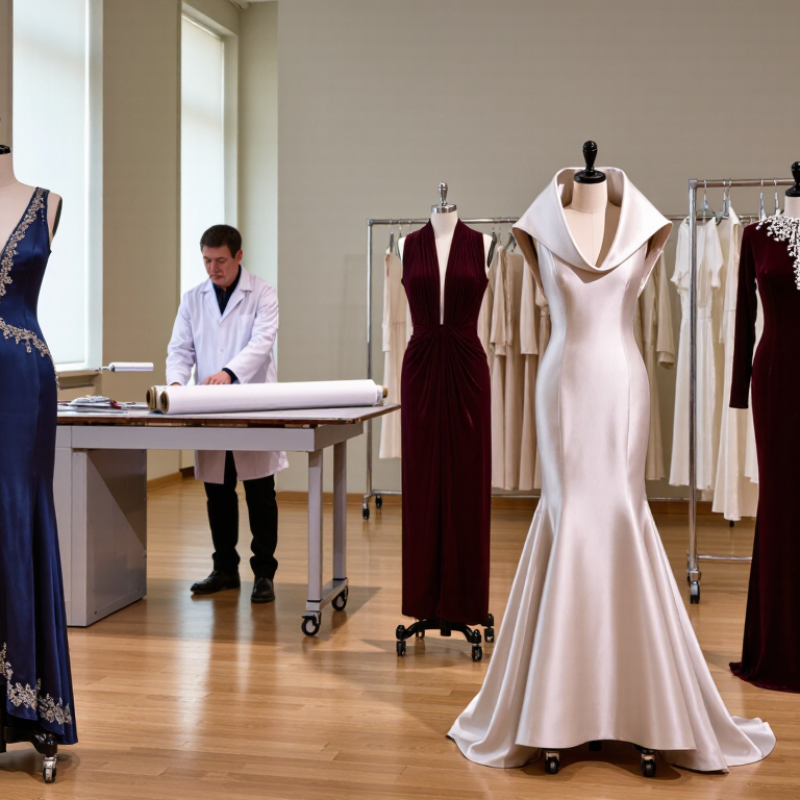
How to Source High Fashion Evening Wear in 2026?

Size 2026 Demand Using McKinsey’s 2–4% Global Fashion Growth Forecast

How to Source High Fashion Evening Wear in 2026?

Size 2026 Demand Using McKinsey’s 2–4% Global Fashion Growth Forecast

McKinsey’s State of Fashion outlook forecasts global fashion growth of roughly 2–4% in 2026. For sourcing teams, this range creates two practical demand cases. If a 2025 evening-wear market equals 100 units, 2026 demand may reach 102–104 units. That is a planning guide, not a guarantee. Occasionwear can move faster than the wider market, but weaker consumer confidence may delay purchases.

Professional reports support careful testing. Euromonitor International continues to identify premiumisation and occasion-led spending as important fashion forces. Bain and Company’s luxury market research also shows uneven regional performance, making a single global buying plan risky. Source smaller initial quantities, then repeat proven silhouettes. Focus on fabric recovery, lining quality, seam finishing, and delivery reliability. A beautiful sample is not enough.

Tips: Build three demand scenarios: 2%, 3%, and 4%. Ask suppliers for low-volume samples and documented production capacity. Check colour under warm evening lighting. Request measurement tolerances before placing orders. Keep a small reserve for alterations. I would also question the forecast itself; growth percentages can hide sharp differences between cities, age groups, and income levels. Oversourcing remains an expensive mistake.

Screen Couture Factories Against ISO 9001, Sedex, and WRAP Criteria

How to Source High Fashion Evening Wear in 2026?

Screen couture factories through three separate lenses: quality systems, ethical practices, and worker protection. ISO 9001 shows whether production controls are documented and repeatable. Request the certificate, expiry date, certified site address, and scope. A certificate covering packaging may not cover evening wear production. Check the details carefully.

Sedex membership alone is not a compliance certificate. Ask for a recent SMETA audit report and review its findings, corrective actions, and closure evidence. Look for issues involving wages, working hours, fire safety, and subcontracting. Speak with the factory’s compliance manager, then compare answers with payroll samples and worker interviews. Written policies can look impressive. Factory floors reveal more.

WRAP certification can support confidence in lawful, humane, and safe manufacturing. Confirm that the certificate belongs to the exact facility making your garments. During a visit, inspect sequins, delicate lace, pressing stations, and packed samples. Ask how rejected pieces are recorded and repaired. High fashion requires precision, but precision can hide rushed labor. I once treated a clean audit as final proof. That was a mistake. Audits are snapshots, not permanent guarantees. Build follow-up checks into sampling, production, and shipment stages. Keep every document linked to the actual factory, not only the trading company.

How to Source High Fashion Evening Wear in 2026? - Screen Couture Factories Against ISO 9001, Sedex, and WRAP Criteria
Factory-screening matrix for premium evening gowns, cocktail dresses, tailored occasionwear, and embellished formalwear. Buyer-defined targets are separated from certification or audit requirements.
Screening Area Dimension Evidence to Request 2026 Screening Benchmark Weight Gate
Quality Management ISO 9001 quality-management certification Valid ISO 9001:2015 certificate; certification body name; scope covering garment manufacturing; certificate validity and site address; latest surveillance or recertification status. Certificate must be valid for the exact production site and relevant manufacturing scope. Verify the certificate directly through the certification body or its public register. ISO 9001 certification is evidence of a quality-management system, not a guarantee of product quality. 18% Pass / Fail
Product and process controls Approved sample records; measurement charts; fabric and trim inspection reports; in-line inspection records; final inspection reports; corrective-action logs; needle and sharp-tool controls. Documented controls for high-risk eveningwear details: boning, corsetry, lining, delicate lace, beadwork, sequins, zippers, hooks, and hand-finishing. Buyer target: documented final inspection before shipment and traceable corrective actions. 12% High
Traceability and change control Purchase orders; lot or roll records; trim cards; subcontractor register; approval history for pattern, fabric, color, and embellishment changes. Each finished style should be traceable to fabric, major trims, production batch, inspection result, and approved pre-production sample. Unapproved subcontracting or material substitution is not acceptable. 8% High
Social Compliance Sedex membership and SMETA audit status Active Sedex site profile; latest SMETA audit report; audit date; scope; auditor details; open non-conformities; corrective-action plan; closure evidence. Sedex membership is a data-sharing platform and is not a certification. Accept a recent, site-specific SMETA audit as due-diligence evidence, while reviewing findings rather than relying only on the audit label. 14% Pass / Review
Working hours, wages, and employment practices Payroll and attendance samples; employment contracts; wage records; overtime records; leave records; recruitment-fee policy; worker grievance records. Legal minimum wages and legally required benefits must be met. Working hours, rest days, overtime, and leave must comply with applicable law and the buyer’s code. No recruitment fees, forced labor indicators, or retaliation for grievances. 10% Pass / Fail
Worker voice and freedom of association Worker interview results; grievance mechanism; anonymous complaint channel; worker-representative records; disciplinary policy; anti-retaliation procedure. Workers must have a confidential grievance channel and must not face retaliation. The factory should respect applicable legal rights related to freedom of association and collective bargaining. 6% High
WRAP Alignment WRAP certification and 12 Principles Valid WRAP certificate; certified facility address; certificate scope and expiry; latest assessment information; corrective-action evidence. WRAP certification should be current and site-specific. Review alignment with WRAP’s 12 Principles, including lawful conduct, prohibition of forced and child labor, harassment, discrimination, freedom of association, health and safety, environmental compliance, customs compliance, and security. 14% Pass / Review
Health, safety, fire, and building controls Fire-risk assessment; evacuation drills; extinguisher and alarm inspection records; emergency exits; electrical inspection; first-aid records; building permits where applicable. Emergency exits must be accessible and unlocked during working hours; evacuation routes must be marked; fire equipment and drills must be documented; serious life-safety findings require closure before production approval. 8% Pass / Fail
Subcontracting and homeworking controls Approved subcontractor list; authorization procedure; subcontractor audit records; production allocation records; homeworking policy; payment records where applicable. No undisclosed subcontracting. Any approved external process, such as embroidery, pleating, printing, or specialized hand-beading, must be declared, traceable, and subject to equivalent social-compliance requirements. 6% Pass / Fail
Couture Capability Technical and hand-finishing capability Machine list; specialist operator skills matrix; approved workmanship samples; embellishment process sheets; defect library; capacity by operation. Demonstrated capability for delicate fabrics, internal structure, clean seam finishing, lining control, couture-level pressing, bead and sequin security, and consistent placement of decorative elements. 7% High
Sampling and development discipline Development calendar; first-pattern and revised-sample records; fit-session comments; sample approval forms; bill of materials; grading and marker records. Factory should provide a documented sample-to-production handover. Buyer target: written approval for pattern, measurements, materials, color, embellishment placement, and packaging before bulk cutting. 5% High
Materials and Risk Material legality and restricted-substance controls Material supplier declarations; test reports where relevant; restricted-substance procedure; chemical inventory; certificates for recycled or preferred fibers when claimed; animal-origin material documentation where applicable. Materials must comply with destination-market requirements and the buyer’s restricted-substance list. Claims such as recycled content, organic fiber, or certified material must be supported by valid chain-of-custody or transaction documentation. 5% Pass / Review
Environmental and chemical management Environmental permits; waste records; wastewater records where relevant; energy and water data; chemical storage procedure; spill-response plan. Legal environmental permits must be current. Chemicals should be labeled and safely stored; hazardous waste must be controlled; significant environmental incidents must be disclosed with corrective-action evidence. 4% Medium
Commercial Readiness Capacity, lead time, and delivery reliability Capacity plan; line loading; historical on-time-delivery data; critical-path calendar; contingency plan; production allocation by style. Buyer-defined planning target: documented capacity reserved for approved orders, milestone tracking from material booking through shipment, and a written escalation plan for material, labor, or equipment disruption. 2% Medium
Data integrity and annual re-screening Signed supplier questionnaire; document expiry tracker; audit-history log; annual management review; notification procedure for ownership, location, certification, or subcontracting changes. Re-screen at least annually and whenever there is a material change. Expired certificates, undisclosed site changes, falsified records, or serious unresolved findings should trigger suspension pending investigation. 1% Pass / Fail
Scoring rule: Score each non-gate criterion from 0 to 5 using documented evidence. Calculate the weighted score using the percentages above. A recommended approval threshold is 80/100, provided that all mandatory gates pass. Any critical finding involving forced labor, child labor, life safety, falsified records, undisclosed subcontracting, or an invalid site certificate requires escalation before purchase approval.
Standards note: ISO 9001 is a quality-management-system standard. Sedex is a responsible-sourcing data platform, while SMETA is an audit methodology commonly shared through Sedex; neither Sedex membership nor a SMETA audit is equivalent to ISO or WRAP certification. WRAP certification is facility-based and should be checked for validity, site address, scope, and current status.

Verify Silk, Satin, and Embellishment Claims with Textile Exchange Data

How to Source High Fashion Evening Wear in 2026?

Sourcing high fashion evening wear in 2026 requires more than touching a glossy fabric. At the cutting table, satin may look like silk, yet satin describes a weave, not a fiber. Ask for the exact composition, production country, and lot reference before approving samples. Then compare claims with Textile Exchange resources and relevant certification documents. Use Textile Exchange’s Materials Market Report for market context, not proof of a garment’s content. The Materials Matter Standard can clarify preferred material claims, but it does not replace product testing. A confident supplier email is useful evidence, but it is not enough.

For organic silk, request an applicable Organic Content Standard certificate. For recycled synthetics, check Global Recycled Standard or Recycled Claim Standard documentation. These standards address chain of custody differently, so read scope details carefully. Request transaction certificates for the shipment, not only a factory’s annual certificate. Satin blends need extra scrutiny, especially with “silk touch” or “eco satin” wording. A laboratory test can confirm fiber content. Burn tests should never replace professional analysis. In sample reviews, I have seen small wording changes create large purchasing errors. Incomplete records remain a warning.

Tips: Photograph the roll label beside the sample card. Record GSM, width, finish, and embellishment weight. For sequins, beads, and metallic thread, request material declarations and test reports. Check whether embellishments affect recyclability or care instructions. Keep certificates linked to purchase orders and shipment lots. Beautiful hand feel can mislead.

Set Price Tiers Using Bain-Altagamma’s 2024 Luxury-Market Data

How to Source High Fashion Evening Wear in 2026?

Bain & Company and Altagamma valued the global luxury market at approximately €1.48 trillion in 2024. Personal luxury goods represented about €363 billion. Growth remained modest, at roughly 1% to 3% at constant exchange rates. These figures suggest caution. Evening-wear suppliers should not build pricing around endless luxury expansion.

Create three clear price tiers for 2026 sourcing.

The entry tier can use refined fabrics, controlled embellishment, and efficient construction.

The middle tier should add stronger tailoring, hand-finished details, and limited customisation.

The highest tier needs exceptional fabric, complex draping, and documented atelier hours. Keep the value visible.

Bain-Altagamma also reported that the luxury customer base declined by about 50 million people from its 2022 peak. That shift makes accessibility important, even for formal clothing. My first tier plan was too narrow. It treated high prices as proof of quality. That assumption needs review.

A better model compares fabric cost, labour time, defect rates, and expected wear per occasion.

The 2024 State of Fashion report from McKinsey and The Business of Fashion also highlighted persistent pressure on luxury demand and consumer value expectations. Therefore, request supplier samples under identical lighting. Check seam balance, lining recovery, zipper performance, and bead security after movement tests. Small failures become expensive returns.

Use a written cost sheet.

Record currency assumptions, minimum order quantities, alteration allowances, and delivery buffers.

Tier names should describe construction, not prestige. That feels more credible.

Approve Samples with AQL 2.5 and ISO 2859-1 Inspection Standards

How to Source High Fashion Evening Wear in 2026?

Evening wear sourcing now demands measurable quality, not attractive prototypes alone. Textile Exchange’s Materials Market Report 2024 recorded 124 million tonnes of global fiber production in 2023. That scale increases pressure on traceability, consistency, and waste control. I recommend approving samples against a written specification before production begins. Record fabric weight, shade, seam allowance, embellishment placement, zipper movement, and pressing results.

AQL 2.5 should support, not replace, professional judgment. Under ISO 2859-1, the inspection level and lot size determine the sample size and acceptance numbers. AQL is not a promise that exactly 2.5% of garments will be defective. Inspectors should classify critical, major, and minor defects separately.

For a sequined gown, a loose bead near the neckline may be major, while a small thread tail inside the lining may be minor. Photograph every finding. Keep sealed samples for comparison.

McKinsey’s State of Fashion 2025 highlights continued supply-chain volatility and cautious purchasing conditions. That makes disciplined approval more valuable. Still, one weakness remains: random sampling can miss a defect cluster. I would add focused checks for high-risk operations, especially handwork, corset structure, and invisible closures.

A garment can pass inspection and still feel wrong on the body. Fit trials and movement tests reveal that gap. Approve carefully. Reflect honestly.

FAQS

How should evening-wear demand be planned for 2026?

Create three scenarios using 2%, 3%, and 4% growth. If 2025 demand equals 100 units, plan for 102–104 units. This is guidance, not certainty. Test before scaling.

Why should buyers avoid one global purchasing plan?

Regional demand can differ sharply by city, age group, and income. Premium spending may grow unevenly. A formal gown may sell well in one market and stall elsewhere. Review local evidence.

What initial order size is safer?

Start with smaller quantities and repeat proven silhouettes. Ask suppliers about low-volume samples and documented production capacity. Oversourcing can leave expensive gowns hanging in storage. That risk is easy to underestimate.

Which sample details should be recorded before production?

Record fabric weight, shade, seam allowance, and embellishment placement. Check zipper movement, pressing results, lining quality, and seam finishing. Use sealed samples for later comparison. Details matter.

How should evening wear be inspected?

Use a written specification and an AQL 2.5 inspection plan. Apply the ISO 2859-1 method according to lot size and inspection level. Separate critical, major, and minor defects. AQL is not perfection.

What defects deserve special attention on embellished gowns?

Inspect loose beads, uneven decoration, weak seams, and damaged linings. A bead near the neckline may create a major defect. A small internal thread tail may be minor. Photograph every finding.

Can random inspection find every production problem?

No. Random checks can miss concentrated defect clusters. Add focused checks for handwork, corset structure, and invisible closures. Inspect high-risk areas separately. Sampling has limits.

Why are fit and movement tests necessary?

A garment may pass inspection yet feel uncomfortable on the body. Test sitting, walking, lifting the arms, and turning. Check whether closures pull or embellishments catch. Fit can expose hidden problems.

What practical checks can improve purchasing decisions?

Examine colours under warm evening lighting. Request measurement tolerances before ordering. Keep a small reserve for alterations and corrections. I would still question the forecast.

Conclusion

Sourcing High Fashion Evening Wear in 2026 requires a structured approach that combines market planning, supplier verification, material transparency, and quality control. Begin by sizing expected demand against a projected 2–4% global fashion growth range, then adjust the estimate for regional preferences, occasionwear trends, and customer spending behavior. Build a shortlist of couture-capable factories and assess their quality systems, ethical practices, workplace standards, production capacity, and documentation against ISO 9001, Sedex, and WRAP criteria.

Material claims should be verified with reliable textile-industry data, particularly for silk, satin, recycled fibers, and embellishments. Supplier quotations can be organized into entry, premium, and exceptional price tiers using current luxury-market performance data, while clearly linking cost to fabric quality, craftsmanship, complexity, and lead time. Before placing bulk orders, approve detailed samples for fit, construction, color, finishing, and durability. Apply AQL 2.5 inspection levels and ISO 2859-1 procedures to create consistent, measurable acceptance standards and reduce quality risks throughout production.

Evelyn

Evelyn

Evelyn is a dedicated marketing professional with a deep understanding of the company’s products, customers, and industry landscape. With a thoughtful, insight-driven approach, she creates clear and engaging content that helps readers understand how the company’s solutions can address real business......